
For NHS radiology departments and imaging providers
Every urgent scan, on the clock.
The 2WW cancer pathway scans in your request queue, found automatically, confirmed by a lead, and tracked against their reporting target until the report is signed.
Identify and confirm
Found automatically, confirmed by a human.
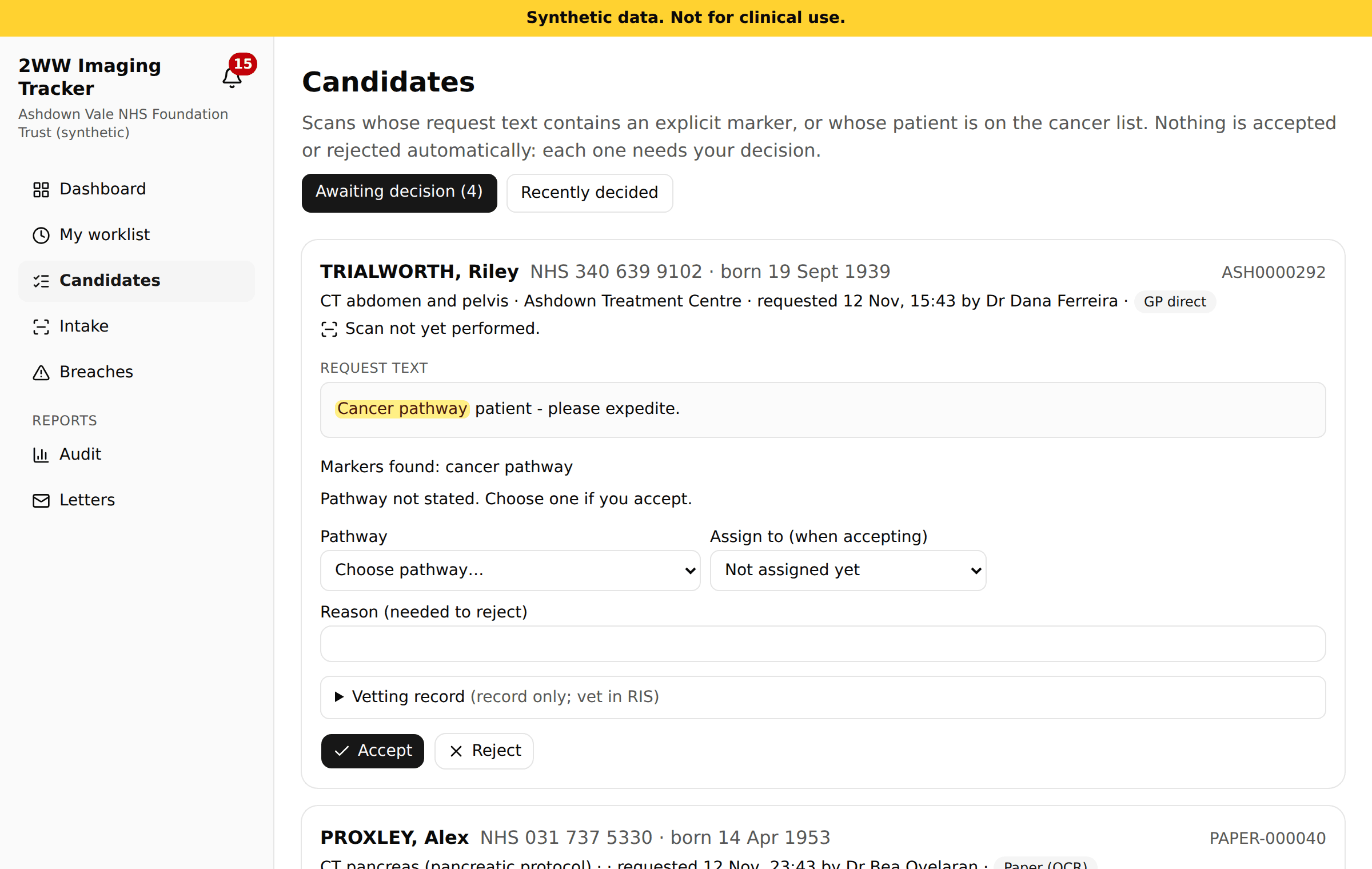
Every request, electronic or scanned paper, is read for explicit pathway markers and matched against your cancer list. The software proposes. A lead decides in one tap.
Alerts
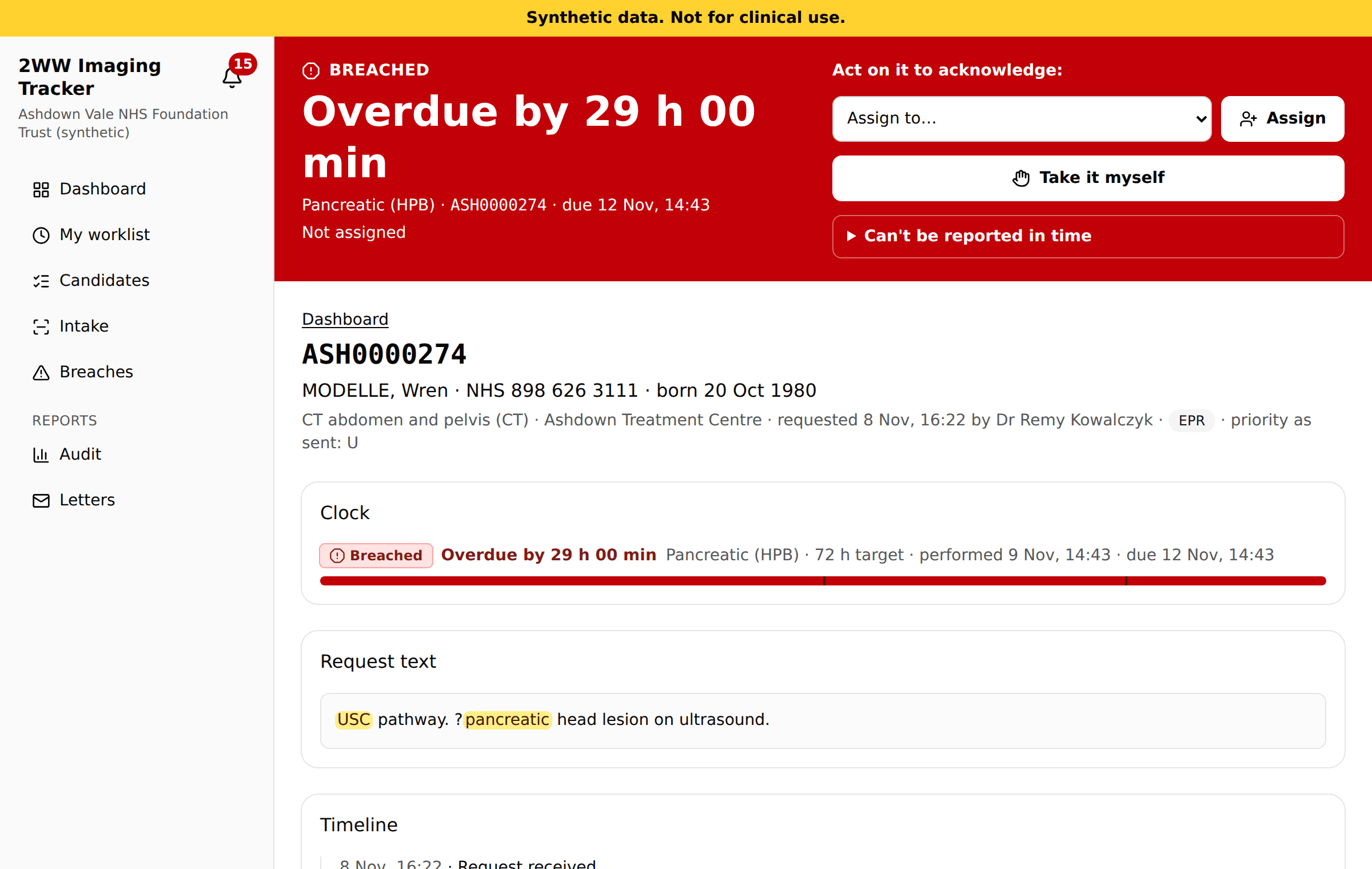
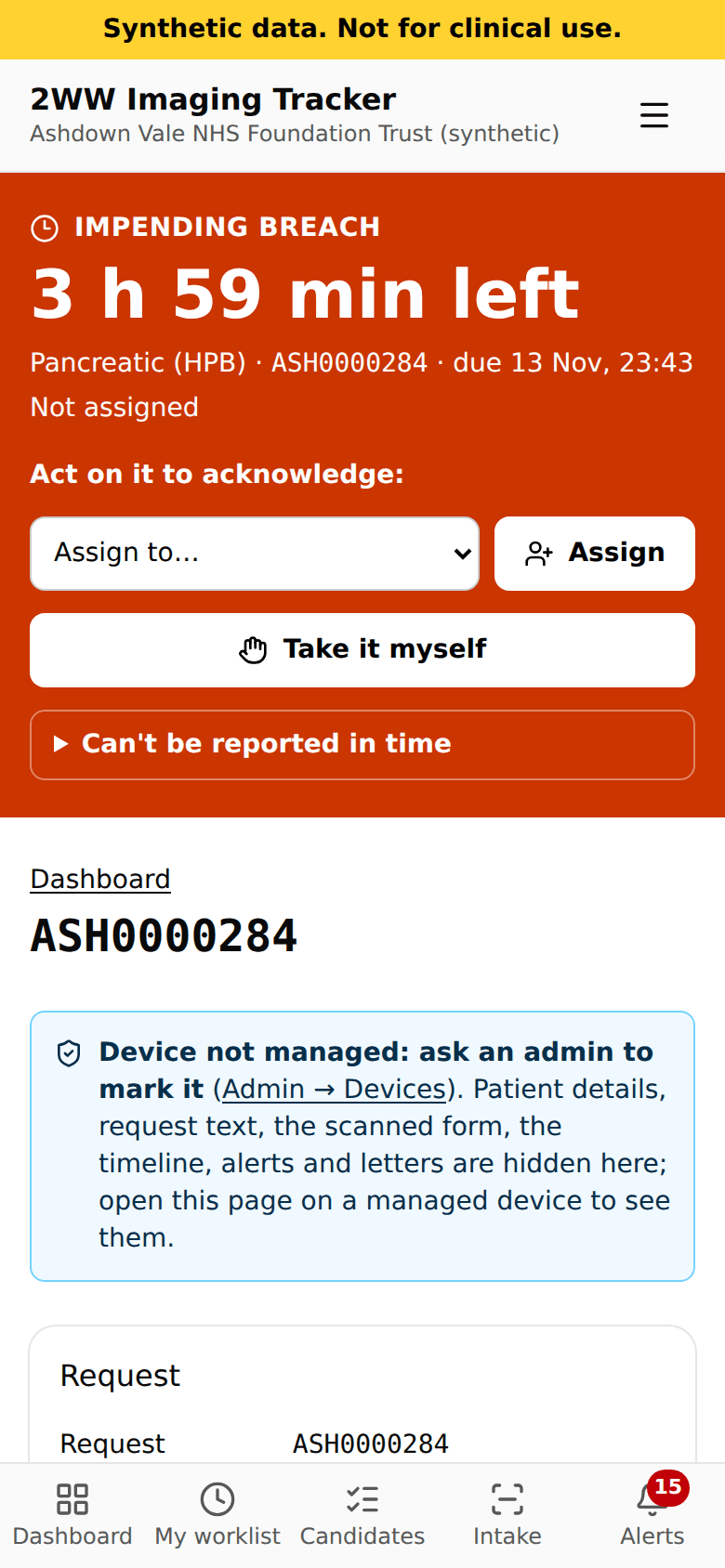
Alerts that reach the lead's phone.
A push that opens on the scan, with the time left in large type and the action it needs.
- Amber alerts the lead and the assignee. Impending goes to the assignee, and the lead hears again if nobody acts within 30 minutes. Breach reaches every lead, whatever was acknowledged before.
- A phone the trust hasn't marked managed never sees patient data: request number, pathway, modality, time remaining and assignee.
- Acknowledging means acting: assign it, take it, or record why it can't be done in time.
Evidence
Measured, not claimed.
No software reads bad handwriting reliably. A form whose NHS number can't be read waits for a person to identify the patient, and the audit page reports OCR confidence every week.
- Marker phrases read by local OCR, on the forms that carry one
- 22/22
- Routine forms wrongly proposed
- 0/18
- Handwriting-style NHS numbers read; the other eight wait for a person
- 2/10
- Automated tests on every change; the browser tests also run against the live site
- 370+
OCR measured on 40 synthetic forms rendered from fonts: real scans will read worse, which is why paper is never decided by software.
Principles and pilot
Sits beside the RIS. Never decides.
Proposes on explicit markers and list matches only. A person confirms every tag.
OCR runs on your own server. No external AI calls. Unmanaged phones see no patient data.
A month in shadow mode beside your administrator's list. Then an HL7 copy from your integration engine. DTAC, DCB0129 and DSPT before real data.